TO START OFF OUR MONTHLY NEWSLETTER ~~
Imbolc Witchcraft Ideas & Ritual Inspiration
Imbolc (celebrated around February 1–2) marks the halfway point between winter solstice and spring equinox. It’s traditionally associated with purification, renewal, returning light, and the Celtic goddess Brigid.
🕯️ 1. Candle Ritual for Returning Light
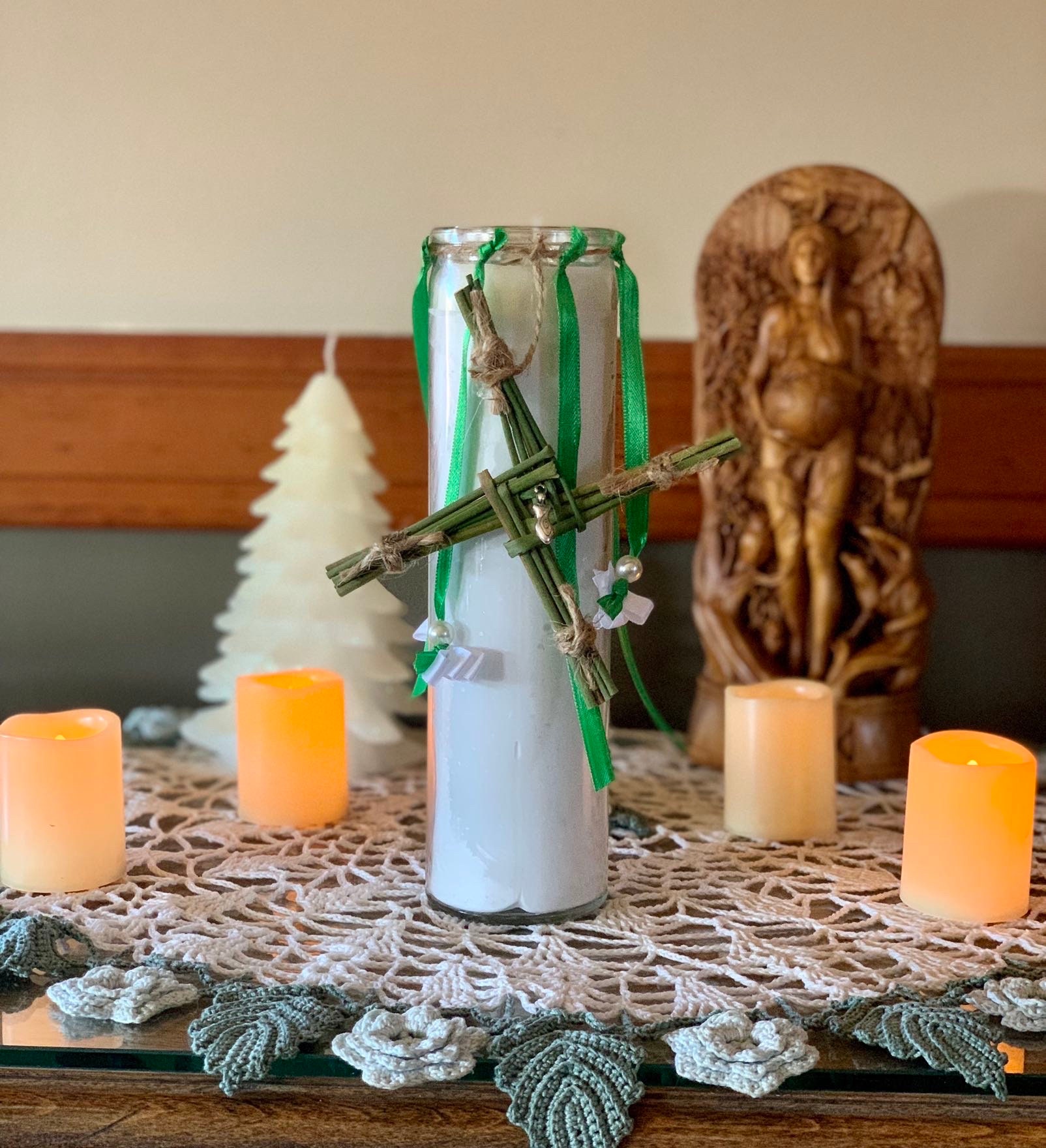

Focus: Renewal, hope, new beginnings
-
Dress your altar in white, cream, and soft green.
-
Light several white candles (or one central candle for Brigid).
-
Write what you are ready to “thaw” or release.
-
Say: “As the light returns, so does my power. I awaken with the earth.”
-
Burn or safely store your petition.
✨ Tip: Carve symbols of the sun, seeds, or spirals into your candle.
🌾 2. Make a Brigid’s Cross



Lupercalia was an ancient Roman pagan festival marked by blood, laughter, and rituals meant to promote fertility and drive away evil spirits. This controversial holiday is celebrated every February and is often tangled up in claims about love and lust because some claim it’s the origin of Valentine’s Day.
Lupercalia’s history is fragmented, debated, and often misrepresented, which is why it continues to confuse modern historians. I did my best to include the most relevant arguments so you could understand all opinions and viewpoints.
What is Lupercalia?
Lupercalia was a Roman festival symbolizing purification, fertility, and removing evil spirits. It can be traced back to at least the 6th century BC, and its name comes from the word lupus, meaning wolf.
This celebration involved animal sacrifices and fertility rituals, but was also a time of feasting and overall debauchery. Over time, this festival evolved and transformed into a celebration focused on fertility, health, and childbirth.
When is Lupercalia 2026?
Lupercalia was traditionally celebrated on February 15th in ancient Rome.
However, it’s important to note some scholars believe the Lupercalia festivals took place on February 13th and lasted through the 15th. However, in 2026, many people choose to celebrate on February 15th.
How to Pronounce Lupercalia
Lupercalia is pronounced Loop-er-kay-lee-uh.
Is Lupercalia a Pagan Holiday?
Lupercalia has very clear pagan origins as an ancient Roman festival, but it’s not widely celebrated as a traditional pagan holiday in modern practices.
However, The Satanic Temple (TST) recognizes Lupercalia as one of its annual holidays. Based on the Roman festival, TST observes Lupercalia on February 15, with February 13 and 14 treated as feast days leading up to the main date.
Within TST, Lupercalia is interpreted as a “hail yourself” holiday, emphasizing personal autonomy and self-respect rather than communal or deity-focused worship. TST draws inspiration from the historical festival while reinterpreting its themes for modern beliefs.
Based on the Roman festival of the same name, Lupercalia falls on February 15. In keeping with the ancient tradition, February 13th and 14th are observed as feast days leading up to the actual holiday.
What we are translating this to in TST is a “hail yourself” day. This idea offers a parallel to the “others-centered” traditions of Sol Invictus.
The Satanic Temple – Holidays
History and Origins of Lupercalia
Lupercalia’s history and origins begin with a Roman legend claiming King Amulius ordered his twin nephews, Romulus and Remus, to be drowned in the Tiber River. This was meant as a punishment for their mother, who broke a vow of celibacy.
However, a kind servant placed them in a basket, which carried them down the river. It was believed a river god kept them safe until becoming trapped in the roots of a sacred fig tree. Eventually, a female wolf picked them up and brought them to her den. She cared for them until a shepherd and his wife eventually took Romulus and Remus in.
As adults, Remus and Romulus named the she-wolf Lupercal, and her den became the location where many future Lupercalia festivals took place. This myth created the symbolism and location of the festival, but evidence suggests the celebration of Lupercalia may predate the Romulus and Remus legend.
Lupercalia Rituals and Practices
**Trigger Warning: Animal Sacrifice**
A Lupercalia festival occurred in several locations, including the Lupercal cave, Palatine Hill, and the Comitium (a public outdoor space). The rituals were carried out by a group of Roman priests known as Luperci, who were typically young men.
The festival started at Lupercal cave by sacrificing a male goat (symbolizing fertility and sexuality) and a dog (representing Lupercal). Sacrificing a dog was rare, and it’s believed only to have occurred during the holiday Lupercalia.
The bloodied ritual knife was then used to anoint the foreheads of two Luperci. The blood was wiped clean with wool dipped in milk (a symbol of purification), and the two young men were said to laugh as part of the rite.
The goat hide was cut into strips, and while still naked or wearing a girdle, the Luperci would use these strips to whip women while parading through the streets. This ritual was believed to increase fertility and was not meant to harm anyone. Instead, it was intended to be symbolic, harmless, and light-hearted.
…[Lupercalia] included a matchmaking lottery, in which young men drew the names of women from a jar. The couple would then be, um, coupled up for the duration of the festival — or longer, if the match was right.
NPR – The Dark Origins Of Valentine’s Day
Scholarly Debates and Disputed Claims
With all that being said, many researchers claim there is no convincing proof or evidence to suggest a “matchmaking lottery” ever took place.
There’s also evidence to suggest Lupercalia festivals existed before the Romulus and Remus mythology. Other scholars claim the concept of a female wolf suckling humans existed long before the Lupercalia legends.
A feature of central importance in the Romulus and Remus legend and one which probably owed much to indigenous (i.e. Etrusco-Italic) influences was the appearance of a she-wolf as foster mother to the twins.
There are indications that the idea of she-wolves suckling human beings already existed amongst the Etruscans – and possibly amongst the Latins – before the development of the Romulus and Remus legend.
P.M.W. Tennant – The Lupercalia and The Romulus and Remus Legend
Later Interpretations of Lupercalia
Like many Pagan holidays, Lupercalia was a big feast with lots of drinking and sexual escapades.
It’s unclear what exact god or deity the Romans honored during this festival, and it remains a topic of debate. In addition to honoring the female wolf Lupercal, it’s been suggested there was also an ancient deity who defended herds from wolves, included in festival celebrations.
There are also suggestions claiming the god Faunas was honored in some fertility rituals.
Like [the Greek god] Pan, Faunus was associated with merriment, and his twice-yearly festivals were marked by revelry and abandon.
At the Lupercalia, a celebration of fertility held partly in his honour each February in Rome well into the Common Era, youths clothed as goats ran through the streets wielding strips of goatskin.
Britannica – Faunus ancient Italian god
Over time, Lupercalia grew in popularity and eventually evolved into a celebration focused on fertility, purification, and childbirth. This celebration was so popular that it survived the fall of the Roman Empire and was even celebrated by Christians for a period of time.
Is Lupercalia the Origin of Valentine’s Day?
Lupercalia is often connected to Valentine’s Day, but the evidence for it is weak. Below, I’ll tell you where this idea came from and why many historians don’t support it.
Some common themes are associated with Lupercalia and Valentine’s Day, including fertility, matchmaking, and the symbolism of the color red. However, many historians claim it’s merely a coincidence, and the connection just isn’t there.
History.com claims Pope Gelasius I banned Lupercalia to replace it with Valentine’s Day –
In the late 5th century A.D., Pope Gelasius I eliminated the pagan celebration of Lupercalia and declared February 14 a day to celebrate the martyrdom of Saint Valentine instead, although it’s highly unlikely he intended the day to commemorate love and passion.
In fact, some modern biblical scholars warn Christians not to celebrate Valentine’s Day at all since it’s thought to be based on pagan rituals.
History – Lupercalia
However, other sources, including Britannica, claim he (Pope Gelasius I) may instead have replaced Lupercalia with the Feast of the Purification of the Virgin Mary (Candlemas), which takes place on February 2nd. (The Goddess Brigid is also celebrated around this holiday as well)
However, when Pope Gelasius I wanted to abolish Lupercalia, he wrote a detailed letter summarizing his opinions and beliefs to Roman senators. Not once did he mention Valentine.
This leads recent scholars to believe both of these claims are untrue. Let’s break down Saint Valentine’s role behind the Lupercalia origin theory –
Saint Valentine
During the age of Roman persecution of Christians, Valentine (who was a priest, bishop, or maybe different people) was executed for refusing to abandon his belief in the Christian god. Valentine, whose name means strength, facilitated secret Christian weddings even when the Roman emperor outlawed them.
Valentine was believed to have healed his jailor’s blind daughter in a different legend. Another version of this story suggests Valentine found true love with the jailer’s daughter. Right before his beheading on February 14th, he sent her a message declaring his love, signing it “From your Valentine.”
Depending on the story, Valentine was executed by either Roman Emperor Claudius I or his successor, Roman Emperor Claudius II.
However, no direct evidence shows this took place, as indicated in the quote below.
One difficulty concerns Claudius, the emperor who supposedly arrested the priest Valentine. No persecutions took place during the rule of the first Claudius, so some historians have suggested it must have been Claudius II.
Yet the evidence is slim there as well, because Claudius II had a very short reign (March 268 to April 270) and spent almost all of his time outside of Italy in military ventures.
Bruce David Forbes – America’s Favorite Holidays: Candid Histories
So, how did stories of Saint Valentine make their way so far into history? Around the 700s, the Venerable Bede, an English monk you may remember from the History and Origins of Ostara and the Spring Equinox post, included the Valentine legend in his list of martyrs.
It’s important to note that Bede did not include ANY of the stories I listed about Valentine above, and it’s believed these were added on later in history. These stories spread like wildfire from that point on.
It’s important to note that while the Roman Catholic Church still acknowledges St. Valentine as a saint, he was pulled from the General Roman Calendar in 1969 due to a lack of credible information regarding him.
It is rather more likely that the saints are the successors to pre-Christian pagan deities connected to certain times of the year and that each preserves a part of a deitys’ aura and mythical functions.
In other words, the imaginal substance ofa saint is composed of a subtle blend of Paganism and Christianity. From this point of view the worship of saints seeks to absorb the polytheistic tendencies of the pre-Christian religion into the monotheistic framework of Christianity.
Phillippe Walter – Christian Mythology Revelations of Pagan Origins
Why Lupercalia Is Probably Not the Origin of Valentine’s Day
While some still believe Lupercalia to be the origin of Valentine’s Day, it’s probably unlikely. So, where do the roots begin for this day of romance? Most likely in the Middle Ages, with the English poet Geoffrey Chaucer.
In France and England in the Middle Ages, it was generally believed February 14th marked the beginning of mating season for birds. This contributed to the belief the middle of February should be a day of love. In his 1375 poem Parliament of Foules, Chaucer was the first to mention St. Valentine’s Day as a day of love.
While there will probably always be some speculation and debate around Lupercalia, it’s undoubtedly an interesting Pagan festival that influences future celebrations!
I hope you found this post on Lupercalia: A Pagan Festival and Holidays helpful!
https://www.thepeculiarbrunette.com/lupercalia-pagan-festival-traditions/
A Cycle of Life and Death: Slavic Goddesses Morana and Vesna
Forever intertwined, Morana, goddess of winter and death, and Vesna, goddess of spring and rebirth, could not exist without each other. However, they could not possibly exist in the same place at the same time either. They are the forces that kept the ancient Slavic world turning in a cycle of death and rebirth. One goddess loved for her beauty and bounty, the other feared and hated for her ugliness and darkness. The modern traditions are an echo of how these two were once celebrated and ritually murdered, and they show how interconnected the goddesses were, and continue to be.
Morana, the Goddess of Winter and Death
Commonly known as Marzanna, her Polish name, Morana (as she is known in Czech, Slovene, Serbian, and Croation) is the Slavic goddess of winter and death. Also known as Moré, in Lithuanian, Morena, in Slovak and Russian, and Mara, in Belarusian and Ukrainian. Some scholars believe that the etymology of her name derives from the Proto-Indo-European name for death “mor” or “mar,” or the Latin word for death “mors.” However, it is unclear if this is the true origin of her name due to her story as it fits into Slavic mythology, as will be discussed later.
While she has been likened to the Greek Goddess Hecate with regards to sorcery, as well as the Roman Ceres, goddess of agriculture, there are some distinct differences that set her apart from these similar traditions. She is most commonly seen as a bringer of death as seen in Slavic mythology when Morana seduced Dazbog, the sun god. Once Dazbog moved on to another lover, Morana poisoned him. As retaliation, Dazbog burned Morana and banished her to Nav (the underworld in Slavic mythology).
This story of retaliation coincides with the movement of the sun throughout the year; it was the belief of the ancient Slavs that the sun descended into the underworld in the winter. In this sense Morana is quite literally winter; she pulls Dazbog into her embrace for the duration of winter but he breaks free in time to bring spring.
There are many sources that contribute to the entirety of the Slavic mythology narrative. While the above story is merely one of the components. Other stories, specifically among Russians, tell of Morana living in “the mirror palace,” which can only be reached through the Kalinov bridge. The palace is protected by snakes and represents the place that the Slavs associate with funerals, once again showing her role as the goddess of death and the underworld.
While most traditions point back to her role as the goddess of death, another tradition states that she was not always the embodiment of death. In fact, it says that she was once a goddess of fertility and life but soon withered into an evil, deadly old crone. It is this story that makes some doubt her name originating from the word for death in many languages, since she was once a goddess of life with the same name.
She is most often depicted as a woman of terrifying appearance, with pale skin, long dark hair, and sometimes she’s shown with the claws and fangs of a wolf. She is sometimes likened to the Germanic demon “Mare” who would come in the night to sit on victims’ chests until they suffocated. In other traditions, she is a young maiden dressed in white. To most she appeared as a withered old woman with an ugly face, however, it is said that to those who were not afraid of her she would appear as the beautiful maiden.
From this portrayal of her as a young maiden comes the dressing of her effigy in the ritual associated with her in Slavic tradition. Traditionally the ritual was held on the fourth Sunday of Lent (once the ritual was allowed by the Catholic church, after being banished in 1420 by the Polish clergy), and in modern days it is held on the fixed date of March 21st.
In the ritual, an effigy of the goddess would be made out of straw and dressed in white bits of cloth, ribbons, and necklaces. It is after this point that some traditions vary. In some rituals, the effigy would be burned, in others it would be paraded to a river or pond to be drowned; in some cases, it would be burned and then drowned. The symbolic death of the goddess would then allow for a swift arrival of spring, and prosperous crops in the coming year.
Today, as in the past, the ritual is typically carried out by young children, especially young girls. It was these children that would carry the effigy as well as stand along the side of the procession, traditionally carrying juniper branches. In modern times the superstition associated with the ritual has all but disappeared. However, school children still participate in singing traditional songs, burning and drowning effigies, and participating in a feast as a way to celebrate the coming of spring.
Vesna, Goddess of Spring and Rebirth
Also known as Devana in the Polish tradition (or Vesna Devana who is more closely associated with fertility and the hunt), Zhiva, and Diva, Vesna represents all that Morana is not. She is the goddess of spring that is born from the death of Morana and winter. As such, she is closely related to the rituals with go along with the death of Morana, as she could not exist without them.
Morana and Vesna cannot exist in the same place at the same time. In the 19th century Vesna’s return was celebrated on March 1st by a procession marching out into the fields with the figure of a clay lark decorated with flowers, while songs were sung to the goddess. This seems to be one of the only traditions that recognizes the goddess in her own right, as opposed to being associated with the death of Morana.
As the opposite of Morana, she is depicted as beautiful, full of life, and fertile. She is typically portrayed as smiling, barefoot, and naked but for a few leaves and flowers covering her body. Her hair is shown as long, like Morana, but she has a bright complexion and rosy cheeks.
Her large breasts are always showing to solidify her role as a goddess of fertility. Sometimes she is shown with an apple and grapes in her hands, other times she is shown with a swallow and a bouquet of flowers - to represent spring and marriage.
These traditions show the singular goddess “Vesna”, but there is a mythology surrounding the plural “Vesnas”. These were female characters associated with spring just like the singular Vesna. They are said to have sat in a palace atop a mountain where they decided the fate of the coming years crops and that of the human inhabitants.
This relates closely to Vesna’s appearance bringing spring and hopefully prosperous crops. The Vesnas also are related to another name for Vesna, Diva. The Samodiva are woodland fairies in Slavic folklore who were only active in the spring and fall when they would come down from their palace atop a mountain.
However, this deviates from the singular Vesna as they are associated with mischief and are more fairy-like than they are representative of a goddess. As such, the singular goddess and her counterpart Morana are more common across the Slavic mythologies.
https://www.ancient-origins.net/myths-legends/morana-vesna-006984
How to Use a Pendulum Properly to Find Answers
Learning how to use a pendulum is a simple way to get answers and connect with your intuition. Many people start with a crystal pendulum, but any balanced object on a string or chain will work. A labeled pendulum board can help you find clear guidance, especially if it’s your first time.
Some people believe the movement comes from spirits or universal energy, but others see it as a way to connect with their subconscious and intuition. Using a pendulum properly can add something special to your witchcraft or spiritual practice.
Please note that I make every effort to ensure this information is correct and accurate through my own experiences and referencing sources throughout OR at the bottom of this article.
What is a Pendulum?
A pendulum is a simple tool witches and spiritual practitioners use for divination and guidance. A weighted object is fastened to a chain or string, allowing it to swing easily and freely (basically not restricted in any way).
Some spiritual practitioners ask yes-or-no questions, while others use a board or tools to receive more in-depth answers (similar to a Ouija Board).
Pendulums can be made from different materials, including crystal, metal, and wood. Each practitioner will have their own preference for the best type, but any well-balanced weight will work. Any length or cord type will work.
How Does a Pendulum Work?
This is a topic of hot debate in the witchcraft community! Some spiritual practitioners believe a pendulum moves because of spirits, deities, ancestors, or even a beloved pet who has passed. It’s a way to receive answers from the divine or connect with otherworldly spiritual energy.
However, others (like myself) believe the movement comes from our subconscious mind and connects with our intuition. This happens because of the ideomotor effect, where tiny muscle movements create motion without us realizing it. It’s our body’s response to what’s in our subconscious mind! Isn’t that fascinating?
Either way, a pendulum works best with clear intentions and focus. Allow yourself to relax and completely open your mind to possibilities.
What is a Pendulum Used for in Witchcraft?
Witches and spiritual practitioners use a pendulum in a variety of ways. It’s great to use alongside tarot or oracle cards for additional insight. It can also help you connect with spirits, ancestors, or even Fae. You can use pendulums in spellwork, divination, energetic healing, and finding lost objects.
How to Choose the Right Pendulum For You
Some beginners are drawn to pendulums that look nice, but the most important aspect is your connection and how you feel when you hold it. The stronger your connection, the easier it is to trust your pendulum and receive answers.
Test your connection by holding the pendulum by the chain and seeing how it feels. Does it swing easily when you ask it to? It might not be the best fit for you if it’s still or takes a long time to respond.
There’s no perfect shape or material. What matters is what works for you; use your intuition! Trust me, you’ll know which one pendulum is best.
Different Types of Pendulums
Some people prefer crystal pendulums, while others prefer metal or wood. However, all kinds of supplies work well for pendulums. You could even DIY your own!
It could be a necklace, a key, a ribbon tied around a Hag Stone, or a ring or metal washer at the end of a string.
Most witches and spiritual practitioners believe the type of material influences the pendulum’s energy. Keep reading to understand the most popular types of pendulums.
What Crystal is Best for a Pendulum?
One kind of crystal isn’t necessarily better than another when using a pendulum. However, I recommend considering your intention if you’re concerned about it. For example, if you’re doing an energetic healing or spiritual cord-cutting, choose a crystal with properties to support your work.
Here are a few popular choices and their intentions to help get you started:
- Amythyst (intuition, spiritual growth, and connects you with the otherworld)
- Clear Quartz (amplifies energy)
- Green Calcite (compassion and balancing emotions)
- Black Obsidian (grounding and protection)
- Rose Quartz (emotional healing)
Wood Pendulum
Wooden pendulums are popular for their grounding and natural energy. Many witches and spiritual practitioners believe in animism. Since wood comes from living trees, it’s connected to the Earth element.
It’s a great choice for anyone who works with Nature spirits or Fae. Wood has a gentle and balanced energy and works well for emotional readings.
If you’re looking for specific types of wood and their spiritual meanings, I recommend checking out my article on The Ogham Alphabet and each tree’s association and meaning.
Metal Pendulum
Metal pendulums are known for their strength, durability, and ability to channel energy. Copper is a favorite choice because it conducts energy well. It also has antibacterial properties, which makes it helpful for healing and energy work.
Brass and silver are also commonly used. Silver is connected to lunar energy and intuition.
Glass Pendulum
Glass pendulums are valued for their clarity and beauty. Some spiritual practitioners believe glass provides a pure connection to one’s subconscious or spirit guide. It’s also a good choice if you prefer something lightweight.
How to Use a Pendulum Properly
Using a pendulum is more than just watching it swing; it’s about building a spiritual connection. Once you’ve worked with a few, you’ll notice each has its own personality, and they often respond in unique ways.
The more you practice, the easier it will be to interpret answers and trust the process. Let me walk you through how to use a pendulum below!
Preparing to Use a Pendulum
It’s always a good idea to ground and center yourself before using a pendulum. This will help keep your mind focused and prevent outside influences from messing with your answers. Center yourself and ground your energy for the most effective results. Remember, a scattered mind always leads to scattered spell results.
Next, you’ll want to cleanse the pendulum to remove any negative energy and ensure the pendulum is only tuned to you. Feel free to do this using the cleansing method of your choice. When you’re done, set an intention. What do you want to know? Are you looking for guidance, clarity, or connection?
How to Protect Yourself When Using a Pendulum
Some witches and practitioners believe spirits or negative forces can influence you or your results. No matter your beliefs, protecting yourself is a smart move. When you work with a pendulum, you want clear answers without any interference.
Try out different methods and see what works best for you:
- Grounding: If you haven’t already, check out the section above on grounding to get centered before you begin.
- Cast a Circle: Some practitioners, especially Wiccans, like to create a protective barrier. This can be as simple as visualizing a ring of light around you or using candles, crystals, or ritual tools.
- Wear a Spiritual Veil: Cover your head with a scarf or hat, which will help shield your energy and keep outside forces from interfering. This is a popular choice when working with spirits or deities.
- Visualize a Protective Shield: Imagine a strong, glowing light surrounding you. It’s impenetrable, like an energetic force field. Another method is visualizing mirrors facing away from you and bouncing anything away that doesn’t serve you.
- Use Protective Crystals: Black tourmaline, Obsidian, and Tigers Eye are great choices. You may even choose to wear them as jewelry.
- Salt, Herbs, or Sigils: A sprinkle of salt, a protective herb like rosemary, or drawing a small sigil in your space will work well.
- Set Intentions Out Loud: Before you begin, say aloud that only helpful, truthful, and beneficial energy is allowed to communicate with you.
How to Use a Pendulum for the First Time
Using a pendulum is pretty simple, but getting clear and accurate answers might take a little practice. Try to think of it as a conversation. You might not get a clear response if you don’t communicate your question clearly. Follow the steps below to avoid common mistakes and build a strong connection.
Get a Grip
- Hold the pendulum by the top of the chain between your thumb and index finger. Keep your grip firm but relaxed.
- If the chain is too long, wrap it around your finger a little or adjust where you hold it. The pendulum should have room to swing freely.
- Rest your elbow on a stable surface to keep your hand steady. If you prefer, you can let your arm hang freely, but avoid shaking or unintentional movement.
Establishing Yes and No
- Before asking your question, you need to figure out how your pendulum responds.
- Start by asking, “Show me yes.” Watch how the pendulum swings. It may move forward and back, side to side, or even in a circle (clockwise or counterclockwise).
- Next, ask, “Show me no.” Pay attention to how it moves differently.
- Repeat this a few times to confirm directions. If it seems unclear, take a deep breath, center yourself, and try again.
Ask the Right Questions
- Pendulums work best with yes or no questions (although other spiritual practitioners may disagree with me on that). The more specific you are, the better your results.
- Good Examples:
- Is this crystal good to use in my spell?
- Should I focus on self-care and rest today?
- Would this job opportunity be good for me?
- Questions to Avoid:
- When will I meet my soulmate? (Pendulums rarely provide helpful timelines)
- What’s my life purpose? (Too broad, not a yes or no question)
What If It Doesn’t Move?
- Sometimes, the pendulum stays still or moves in a way that doesn’t fit yes or no. This could mean:
- It doesn’t know the answer (or YOU’RE not meant to know yet).
- The question is unclear or too complicated
- You need to cleanse your pendulum and try again later
Learning to use a pendulum is about building trust with it. Keep your energy calm, ask clear questions, and don’t force an answer. The more you practice, the better your results will be!
How to Use a Pendulum for Divination
Pendulums are a quick and easy way to get answers, which makes them a very popular tool for divination. You can use them to help make decisions, check the energy of a situation, or decide if now is a good time to take action.
Some spiritual practitioners even use it to locate lost objects. Try this for yourself by holding the pendulum and asking if you’re facing the right direction. Move through this step-by-step until you find the object you’re looking for.
Pendulum divination is also very handy in spellwork. If you’re crafting a spell, you can ask if you’ve added enough herbs, if a certain candle color is best, or if a specific day is good for spellcasting. You could even ask if your spell worked or if you need to cast it again.
Remember to keep your questions simple and clear. This allows the pendulum to help you without overcomplicating the process.
How to Use a Pendulum for Healing
Pendulums can be powerful tools for energetic healing in addition to medical advice from your doctor. Some practitioners use them to scan the body for areas holding tension, pain, or imbalanced energy.
To do this, ask the pendulum simple questions like, “Is there a blockage here?” or “Does this area need attention?“. This will help you better understand where to focus your healing efforts.
If you’re using a pendulum to help someone else, I recommend asking it to connect with their ancestors, spirit guides, or even a beloved pet that’s passed. This will help give you additional insight and ensure the answers aren’t meant for you.
How Do I Use a Pendulum to Find Answers From Spirits?
Connecting with spirits through a pendulum is a lot like automatic writing or meditating; you need to relax your mind. I prefer to enter a trance-like state by focusing on my breathing in a quiet space, free from distractions. I also prefer to wear headphones and listen to hemi-sync tones, but the choice is up to you!
Before you begin, read the section above, How to Protect Yourself When Using a Pendulum. It will help you set up protection to keep out unwanted energy. When you’re ready, call on the spirit you wish to speak with and ask them to guide the pendulum.
You can connect ancestors, spirit guides, pets who’ve passed away, or even deities like Brigid, Hekate, Medea, and Rhiannon. Remember to be patient. Spirits don’t always answer immediately, or the message may differ from what you expected.
How to Use a Pendulum Board
A pendulum board adds another layer of depth to divination. This advanced technique offers more in-depth answers that go beyond simple yes/no responses. Feel free to use whatever board resonates with you. It can be simple or more intricate with letters and numbers.
Choose a Board
Pendulum boards are very popular and come in many different styles and colors. Some feature yes/no/maybe, while others include letters, numbers, or symbols, similar to a Ouija board. You can also easily create your own by writing on a piece of paper.
Connecting with the Board
Hold the pendulum over the board and ask it to connect with its energy. Try saying, “Will you work with this board?” or “Can you show me how you’ll respond on this board?”
Test the Connection
Ask a few establishing questions to ensure the pendulum’s responses align with the board. If the pendulum answers correctly, feel free to proceed. If not, restart or try a different board or pendulum. Some examples include:
- “Is my name [insert your name]?”
- “Am I currently indoors?”
- “Is today [insert day of the week]?”
Working with Complex Boards
Some boards include words, months, or letters. To work with these boards, allow the pendulum to hover over each section or word and notice where you get the strongest response. For example:
- “Which month will be my most prosperous?” – Move the pendulum over each month and see which one reacts.
- “What message do I need to hear?” – Hover over the alphabet, writing down each letter the pendulum selects to form a word or phrase.
Patience is Important
If the pendulum doesn’t respond immediately, take a deep breath and try again. Sometimes, a different pendulum or board works better for certain questions or energies.
THAT'S ALL FOR THIS MONTH'S NEWSLETTER.... HOPE TO SEE YOU AROUND WITCHES MOON!
- SunKat & Evil Magician
and
The WITCHES MOON Team
